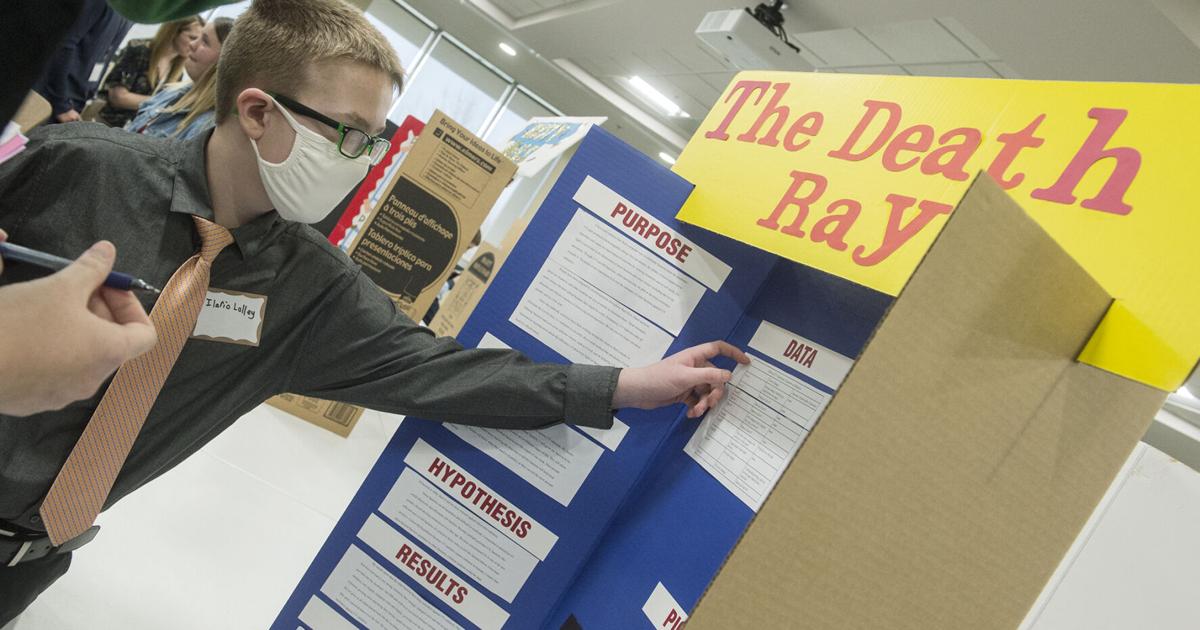
For the first time in two years, potential future scientists gathered Tuesday in Missouri Southern State University’s Connor Ballroom at Billingsly Student Center to show off research on myriad topics and problems.
The 33rd annual MSSU Regional Science Fair was conducted in person for the first time since 2019, according to Rabindra Bajracharya, fair director and Missouri Southern physics instructor.

“The 31st didn’t happen because of COVID, and last year was virtual,” Bajracharya said. “We planned to do this in hybrid format, in person as well as in virtual format for those who could not attend in person, but no one thing to do it in virtual format. Everyone came in person. It’s really nice and really exciting to have it back. We can see the excitement in children’s faces. They are very happy to be back in person to present their research here. ”
Bajracharya said 60 students entered the fair – 11 in the senior category for ninth through 12th grades and 49 in the junior category for fifth through eighth grades.
The students are from schools in Jasper, Newton, McDonald, Barton, Vernon, Barry, Lawrence, Cedar, Dade and St. Clair counties in Missouri; and Neosho, Crawford, Montgomery, Labette, Bourbon and Cherokee counties in Kansas.
Categories include behavioral and social sciences; cell, molecular, and microbiology; chemistry and biochemistry; computer science, engineering, and mathematics; earth and environmental sciences; human and animal sciences; physics and astronomy; and plant sciences.

Bajracharya said students have already learned much abut the research process and research methods from the scientific research they did in preparation for the event, but at the fair, they’re learning much more.
“They not only learn science-related stuff in the science fair, they also learn about things that are not related to science,” he said. “Some things like networking, how to communicate with people, how to make a nice display. They learn about analytical thinking, critical thinking, which is very important for their career. No matter which field they choose, they still need analytical thinking and critical thinking. ”
Pets and CBD oil
Joplin High School senior Dakota Agee presented the results of her research into how the topical application of CBD oil can affect mammals.
In the case of her experiment, she used mice, but her research can be applied to pets.
“My dog has a lot of stress,” Agee said. “I was reading about CBD oil, and so I was thinking I could do a project on CBD oil and pet stress to see if it lowers that correlation and reduces those stress levels.”
Agee said she was taking a research class at Joplin High School to learn about the research process and that her science project is the result of that class.


In addition to learning about the research process, Agee said her instructor drilled her on presenting her work and her materials even before the results of her research were calculated.
“It’s very nerve-wracking, but it’s also very fun because I’ve worked really hard on this, so I’m happy to share what I’ve found,” Agee said. “I like talking to people about it. I think it’s very interesting. I’m very interested in this, and I think a lot of other people are specifically interested in my experiment because a lot of people have pets and they can relate to what I’m talking about. ”
Defying gravity
Jeanna Smathers, a sophomore at College Heights Christian School, wanted to find out the optimum angle to fire a pingpong ball from an air cannon to get the maximum distance out of the combination.
She built an air cannon from instructions she found on YouTube, then spent an evening conducting experiments firing the ball at a given air pressure from different angles. She spent another day figuring out the math and working out her results.
“I hypothesized that 30 degrees would be the angle that shot the ball the farthest,” Smathers said. It was sort of a guess-and-check because I assumed if it was a lower angle it wouldn’t have enough height or arch for it to go the farthest. Meanwhile, if it was higher, it would have been too high so much that it wouldn’t go the distance. I figured out that 30 degrees was in fact the angle where the ball went the farthest. ”
Smathers said she can think of a number of real-world applications for her research, such as the circus.
“So they have this stunt called the human cannonball where they shoot a human out of a cannon,” she said. “If I was in charge of the circus I would figure the kinematic formula to figure out where this person would land. I’d place the safety net there, but if I didn’t test it first with a dummy test, it wouldn’t be good because the person may not land there. “
She can also use this in her extracurricular activities.
“I am a tennis player, and we have a ball machine at practice,” Smathers said. “We set it at a speed, and we angle the machine so the ball goes where we want to go. But we don’t know what angle to set it at, so we work through trial and error. … So going into next season I’ll be able to use my research here, and I’ll be able to know where I need to tilt the machine. ”