


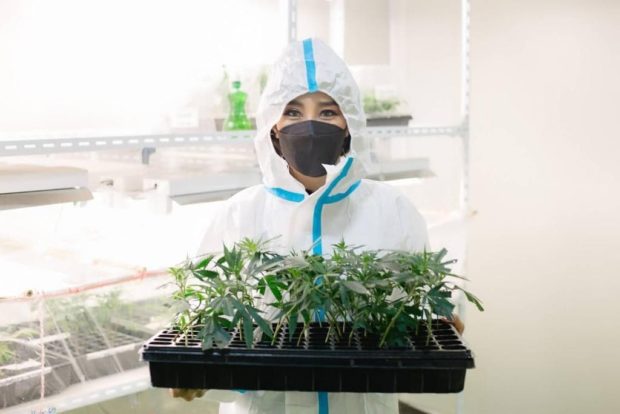
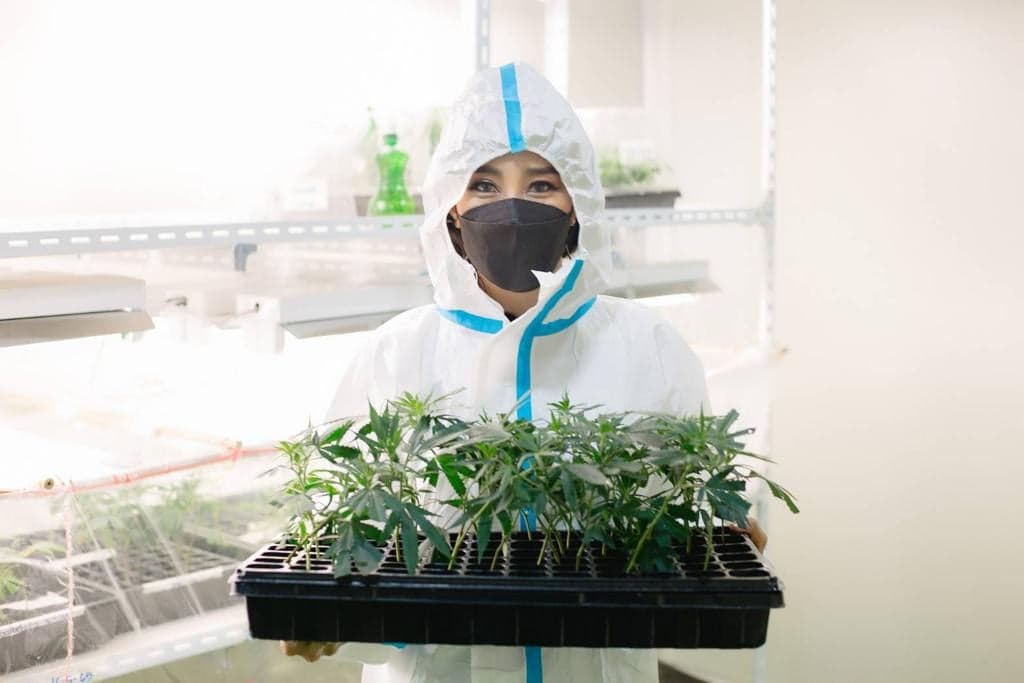
Jongkasem Julakham-Plato showing cannabis seedlings. PHOTO COURTESY OF JONGKAS JULAKHAM-PIATON

Thailand officially withdrew Category 5 cannabis and hemp from its narcotics list on June 9th.
This means that these previously highly banned plants can now be grown at home for culinary and medicinal purposes.
If you are in Thailand, you can also smoke privately and enjoy its medicinal and health benefits by eating groceries and drinking tea, coffee or anything with cannabis.
Those who want to grow cannabis plants for commercial purposes, however, have yet to get permission from the authorities.
But a degree in cannabis science? Well, this is one more step to turn Thailand into a cannabis hub in Southeast Asia.
Jongkasem Julakham-Platon, a restaurateur and owner of Toto Inasal, a Philippine and Thai-owned restaurant in Bangkok, has partnered with Waldo 18. The company offers commercial supply chains to grow, process and sell medicinal plants. and its derivatives.
The Waldo Institute in Petchburi, its education and research group, is accredited by the Office of the Higher Education Commission (OHEC) of Thailand. It is under the supervision of Suan Sunandhta Rajabhat University Faculty of Science. The institute offers advice, training, cross-breeding experiments, etc.
“The institute offers a bachelor’s, master’s and doctorate degree in cannabis science. They are also developing a new breed called Rocher Breed. It is a highly resistant cannabis breed with a high survival rate. Toto Inasal will also help in the experimenting with cannabis products with food and drink, “said Julakham-Plato.
He also said that Toto Inasal is the sole representative of Waldo 18 for the Philippine market, as well as for future collaboration with Philippine universities or research centers.
Hemp vs marijuana
There is a difference between hemp and marijuana, even though they belong to the same cannabis species. Types of marijuana (indica) are shorter and have thick leaves, while hemp (sativa) grows taller and has feathery leaves.
The difference also extends to the chemical compounds: cannabidiol (CBD) and tetrahydrocannabinol (THC). Hemp contains less than 0.3% THC, while marijuana has a higher THC content. THC is a psychoactive substance. Both contain CBD, the main component of the oil extracts from the leaves and are not psychoactive. Recently, scientists and researchers have stated that there really is no difference and there is only one strain: cannabis sativa L.
Will ASEAN stay the same?
“It is too early to predict whether other Asian countries will continue to lead Thailand. If the Thai market gains momentum, cannabis exports will continue,” Julakham-Plato said.
“Therefore, there are more chances that other ASEAN countries will also consider legalizing cannabis to take their share of the global market. Muslim-dominated Muslim and Philippine countries may not be on the top list of countries , but they could be consumers of cannabis by – products, “he said.
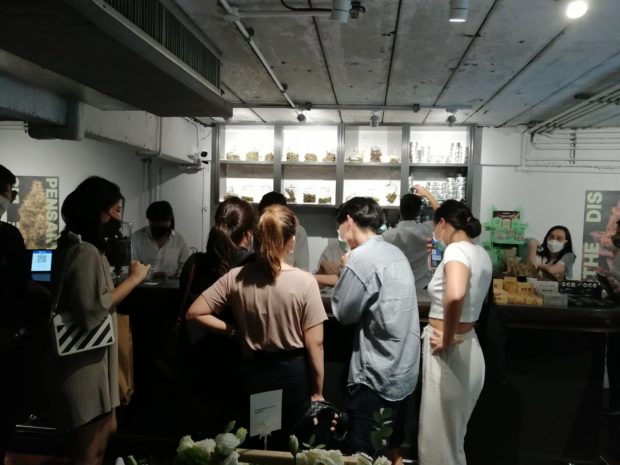
Scene at The Dispensary, a newly opened establishment where people can buy cannabis for medicinal purposes. PHOTO COURTESY OF JONGKAS JULAKHAM-PIATON
In December 2018, Thailand became the first Southeast Asian country to legalize the use of cannabis for medicinal purposes. Initially, only state hospitals could dispense cannabis oil (CBD oil) to patients undergoing chemotherapy and suffering from various chronic conditions with a doctor’s prescription.
In January 2019, the World Health Organization (WHO) changed the classification of cannabis from Annex 4 to Annex 1 “due to the evidence that some cannabis preparations have a medical use.” . List 4 is the list of the most dangerous substances such as heroin and carfentanil. This also prompted the United Nations Commission on Narcotic Drugs (UNODC) to withdraw cannabis from Table 4 of the 1961 Single Convention on Narcotic Drugs. But most countries in the region have not yet considered this.
Cannabis is grown in parts of Myanmar, Cambodia, Vietnam, Laos, and the Philippines. It has a long history in Southeast Asia. It is not known exactly when it was first introduced to Thailand and the rest of the region. Ganja ((กัญชา) is a Sanskrit word and also a Thai word for marijuana, it has been used as a medicine, especially as an analgesic, food, flavoring, tissue and for its psychedelic effects.

In Vietnam, small-scale cannabis growers can be fined between 2 and 5 million VND ($ 86.16-215.40) and imprisoned for six months to seven years.
In Cambodia, cannabis is illegal, but there are “happy restaurants” across the country that sell cannabis-infused foods.
Although many indigenous peoples in Laos are widely cultivated and consumed as food, cannabis remains illegal.
Both Laos and Cambodia are planning to study cannabis for medical purposes.
In Malaysia, Indonesia, Brunei and Singapore, cannabis continues to be a narcotic. Criminals face prison sentences and the worst, the death penalty.
The Myanmar government bans the sale or supply of cannabis. If convicted, the offender can be punished with a minimum of 15 years in prison, with no limit to the length of his sentence. They also run the risk of being sentenced to death.
In the Philippines, consuming and possessing cannabis, even in small amounts, is punishable by imprisonment and fines of up to 10 million euros under Republic Act 9165 or the Comprehensive Dangerous Drugs Act of 2002.
Chuck Manansala, president of Masikhay Research, a medical cannabis research center based in the Philippines, believes the legalization of cannabis in the Philippines is beyond doubt at the moment.
Manansala and his group have been advocating for medical cannabis since 2014. He was also part of the group that drafted the first bill before the House of Representatives to legalize medical cannabis in the Philippines. Isabel Rodolfo Albano III’s deputy presented it as Bill no. 4477, known as the Medical Compassion Cannabis Bill, in the 16th Congress. It was re-introduced to the 17th Congress of the Philippines and is currently listed as the House’s 180th bill.
“Illegally cured”
Jheck Alcera suffered from insomnia, depression and alcohol addiction in 2010. He claimed that cannabis “cured” her, albeit “illegally” because of the stigma and laws that criminalized her consumption.
In 2017, Alcera met fellow advocates of the Philippine Cannabis Compassion Society, made up of doctors, lawyers and others like her who suffer from various diseases.
“No one should be imprisoned because of a plant,” Alcera said.
“The benefits of legalizing cannabis outweigh its disadvantages. Advocacy groups must popularize the issue and vigorous educational campaigns must be maintained until the ideology of the war on drugs is neutralized. These campaigns should be based on science, human rights and the concept of bodily sovereignty, “Manansala said.
Julakham-Plato said the use of cannabis in traditional Asian medicine is nothing new.
“There are many benefits, from medicinal to cosmetic, and the only downside is the bias of the cannabis people. The laws are in place, the people are well informed and the government has done a number of experiments and calculations. I think there will be no problem, “said Julakham-Plato.
Thailand also planned to distribute one million seedlings nationwide. On June 10, the Buriram Province Ministry of Health delivered 1,000 initial seedlings.
People can also buy cannabis leaves for smoking (in private) at the cannabis dispensary that opened on June 9th. Groceries, beverages and oils are available at many cannabis cafes in Bangkok and other provinces.
Cannabis, or any cannabis derivative, such as groceries, cosmetics, and oils, should not be taken outside of Thailand at this time.
TSB
Subscribe to our daily newsletter
Read Next
Don’t miss the latest news and information. 

Subscribe to INQUIRER PLUS to access The Philippine Daily Inquirer and more than 70 titles, share up to 5 gadgets, listen to the news, download them as soon as 4am and share articles on social media. Call 896 6000.


